Friday, March 6, 2026
Home Blog Page 35

Xiaomi Mix Fold 3 vs Samsung Galaxy Z Fold 5: Price, Specifications Compared

0
Xiaomi Mix Fold 3 vs Samsung Galaxy Z Fold 5: Price, Specifications Compared

[ad_1]

Xiaomi Mix Fold 3 — the latest foldable phone from the Chinese smartphone brand was launched on Monday, August 14 in China. The book-style foldable runs on the Snapdragon 8 Gen 2 SoC and packs Leica-branded quad rear cameras. The debut of Mix Fold 3 less than a few weeks after Samsung released the Galaxy Z Fold 5 last month indicates that stiff competition in the foldable smartphone is heating up. With the new Galaxy Z Fold 5 and Xiaomi Mix Fold 3, both the tech giants are trying to combine smartphone and tablet experience. The Xiaomi Mix Fold 3 might emerge as an alternative to the Galaxy Z Fold 5, if the former comes to international markets outside China.

Let’s compare Xiaomi’s Mix Fold 3 and Samsung’s Galaxy Z Fold 5 based on their design, features, performance, and battery.

Xiaomi Mix Fold 3 vs Samsung Galaxy Z Fold 5: Price

The price of Xiaomi Mix Fold 3 starts at CNY 8,999 (nearly Rs. 1,02,000) for the 12GB RAM + 256GB storage model in China. The 16GB RAM + 512GB model is priced at CNY 9,999 (nearly Rs. 1,14,500), while the 16GB RAM + 1TB storage model costs CNY 10,999 (nearly Rs. 1,26,600).

Samsung’s Galaxy Z Fold 5, on the other hand, is a bit more expensive with a starting price tag of Rs. 1,54,999 for the base 12GB RAM + 256GB RAM and storage configuration. The 512GB and 1TB storage variants cost Rs. 1,64,999 and Rs. 1,84,999, respectively. The pricing would give Xiaomi undoubtedly an upper hand in the competition, but the new Xiaomi Mix Fold 3 is currently available only in China.

Xiaomi Mix Fold 3 vs Samsung Galaxy Z Fold 5: specifications

Both phones run Android 13 with each brand’s own skin on the top. The Xiaomi Mix Fold 3 comes with MIUI Fold 14, while the Galaxy Z Fold 5 ships with One UI 5.1.1.

On the Xiaomi Mix Fold 3, users get a larger 8.03-inch foldable E6 AMOLED LTPO inner display with a 2K resolution and up to 120Hz refresh rate. The Galaxy Z Fold 5, in contrast, is equipped with a 7.6-inch QXGA+ Dynamic AMOLED 2X Infinity Flex display on the inside with an adaptive refresh rate ranging from 1Hz to 120Hz. The Xiaomi handset features a 6.56-inch full-HD+ AMOLED cover display, while Samsung’s offering is equipped with an external 6.2-inch full-HD+ Dynamic AMOLED 2X Display.

The processor powering both phones is identical. The Xiaomi Mix Fold 3 runs on Qualcomm’s Snapdragon 8 Gen 2 SoC, paired with up to 16GB of RAM and a maximum of 1TB storage. The Galaxy Z Fold 5 features a custom Snapdragon 8 Gen 2 Mobile Platform for Galaxy SoC under the hood, along with up to 12GB of RAM and up to 1TB of storage.

The Xiaomi Mix Fold 3 and Galaxy Z Fold 5 have different rear camera setups. The former packs a Leica-tuned quad rear camera unit, comprising a 50-megapixel Sony IMX 800 primary camera with optical image stabilisation (OIS), 12-megapixel wide-angle sensor, 10-megapixel periscope sensor, and 10-megapixel telephoto sensor. The Galaxy Z Fold 5 has a triple rear camera setup comprising a 50-megapixel wide-angle camera with OIS, a 12-megapixel ultra-wide-angle camera, and a 10-megapixel telephoto camera. It also includes a 10-megapixel camera on the cover display.

For selfies and video calls, the Xiaomi Mix Fold 3 sports a 20-megapixel camera. The Galaxy Z Fold 5, on the other hand, has a 4-megapixel under-display camera.

samsung galaxy fold 5

Xiaomi is offering the Mix Fold 3 in 256GB, 512GB, and 1TB storage options, while the Galaxy Z Fold 5 is available in 256GB, 512GB, and 1TB storage variants. Connectivity options and sensors are almost similar on both foldable. Samsung’s foldable comes with support for the S Pen stylus. Both models sport fingerprint sensors for authentication as well. The Galaxy Z Fold 5 has an IPX8 rating for water resistance, while Xiaomi’s phone has no such rating.

The Xiaomi Mix Fold 3 is backed by a 4,800mAh battery with support for 67W wired Turbo fast charging and 50W wireless charging. Meanwhile, the Galaxy Z Fold 5 features a slightly smaller 4,400mAh battery and supports 25W wired charging along with Fast Wireless Charging 2.0 that offers 15W charging speeds. It also offers Wireless PowerShare for charging other wireless charging-supported devices.


Affiliate links may be automatically generated – see our ethics statement for details.

[ad_2]

Source link

Acer Swift Go 14 Review: Striking the Right Balance

0
Acer Swift Go 14 Review: Striking the Right Balance

[ad_1]

Acer introduced the Swift Go laptop series at CES 2023, powered by both Intel and AMD CPUs. The AMD Ryzen-powered laptop was launched in March of this year in India, and today we’ll be reviewing the base model of the Swift Go 14. It is aimed at the urban youth who would want a stylish and premium looking laptop which is portable and powerful. Let’s find out if the Swift Go 14 checks all the boxes.

Acer Swift Go 14 price in India

The Acer Swift Go 14 is available in Prodigy Pink and Pure Silver colours. On the Acer India online store, the laptop starts at Rs. 59,999 and is the variant we’ll be testing. This comes with an AMD Ryzen 5 CPU, 8GB of RAM, and a 512GB SSD. For about Rs. 5,000 more, you can get the same configuration but with 16GB of RAM.

Acer Swift Go 14 design and features

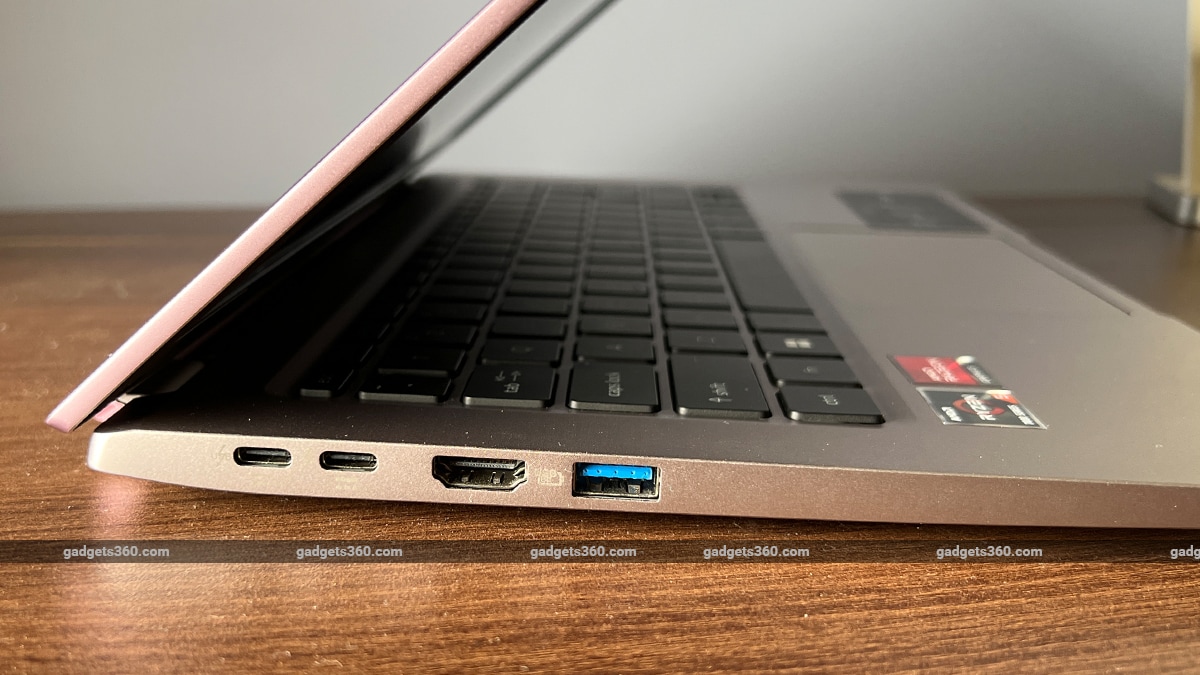
The Acer Swift Go 14 features a metal chassis which is what gives it a premium look and feel. It’s also quite compact and lightweight measuring just 15.9mm in thickness and 1.25kg in weight. The pink variant actually looks nice and grows on you after a while. You get a good variety of ports for a 14-inch laptop and these include two USB 3.2 (Gen1) Type-C ports for charging, HDMI, USB 3.2 (Gen1) Type-A port, USB 2.0 Type-A port, headphone jack, and a Kensington lock. There’s no SD card reader of any kind, which I don’t think is a total loss. The right side of the laptop also has two LEDs for the power and activity status.

acer swift go 14 review back gadgets360 ww

The Acer Swift Go 14 features an all-metal chassis and is fairly light


The backlit keyboard on the Acer Swift Go 14 is nicely laid out, and the keys themselves are responsive and not noisy. There’s a fingerprint sensor in the power button which wobbles when pressed, unlike the rest of the keys, but it works fine when it comes to authentication. The trackpad does a good job of tracking and you get a decent amount of room to rest your palms.

The 14-inch display has a 16:9 aspect ratio, making it ideal for watching most video content. The Acer Swift Go 14 uses an IPS display panel with a full-HD (1920×1080) resolution and comes with a matte, anti-glare finish. The display has a rated maximum brightness of 300 nits which I found to be more than adequate. The 1080p webcam is quite inconspicuous and is located just above the display. The Acer Swift Go 14 ships with just a 65W USB Type-C charger in the box.

Acer Swift Go 14 specifications and software

The Acer Swift Go 14 features an AMD Ryzen 5 7530U CPU featuring six CPU cores. It’s part of AMD’s mobile CPU refresh which was announced during CES this year. However, this model is based on a refreshed Zen 3 architecture, unlike the 7040 series which uses the latest Zen 4 architecture. This is currently the only CPU configuration that Acer offers in India for the Swift Go 14 series. Storage is taken care of by a 512GB NVMe PCIe Gen3 SSD, and there’s 8GB of RAM. The laptop also features Wi-Fi 6E, Bluetooth 5.1, and a 3-cell 50WHr battery.

acer swift go 14 review ports hinge gadgets360 ww

The Acer Swift Go 14 features a good number of ports for a 14-inch laptop


The Acer Swift Go 14 ships with Windows 11 Home, along with the usual preinstalled programs such as Microsoft Office Home and Student, McAfee antivirus, and bunch of softwares by Acer for system diagnostics and keeping drivers up to date.

Acer Swift Go 14 performance and battery life

General performance of the Acer Swift Go 14 is very good. It runs cool and the fans are not audible when performing simple tasks, but you can hear them faintly during gaming. I found the typing angle to be quite ergonomic as the base is propped up a bit when the lid is open. The keyboard backlighting is also soothing and the display gets sufficiently bright even for daytime outdoor use. Applications are quick to load and I never really felt any lack of power.

The stereo speakers get loud but don’t sound all that great. Games run decently well with the onboard Radeon graphics. I was able to get smooth framerates in Fortnite with medium graphics and running at the display’s native resolution. In synthetic gaming tests such as 3DMark, the Acer Swift Go 14 returned a score of 1,268 in the Time Spy test suite, and 13,570 in Night Raid. CPU and SSD performance was also very good. The laptop scored 566 and 3,664 points in Cinebench R20, and returned an average read speed of over 1.5GB/s for both sequential and random tests in SiSoft Sandra. Write speeds were lower coming in under 900MB/s.

Video rendering and encoding performance was also quite good. The Acer Swift Go 14 took 45 seconds to encode a 1.3GB AVI file to H.265 MKV, while the BMW test scene in Blender took 6 minutes, 18 seconds to render. These were lower (better) times compared to something like the Intel Core i5-1335U CPU which we recently tested in the Dell Inspiron 16 2-in-1.

acer swift go 14 review keybaord gadgets360 ww

The keyboard on the Acer Swift Go 14 is comfortable to type on


Battery life is another highlight of the Acer Swift Go 14. Considering its size, it ran for an impressive 3 hours, 26 minutes in the Battery Eater Pro benchmark. With my daily workflow, I was able to get roughly 7-8 hours of non-stop use before the battery went below 10 percent. By these estimates, it should be possible to get even up to 10 hours of use on one charge (or more), if you don’t use it non-stop. The laptop can be charged fairly quickly using the bundled charger. You get roughly a 70 percent charge in an hour.

Verdict

It’s really hard to find fault with the Acer Swift Go 14 as it does everything you’d expect from a thin and light laptop, and this is before you even consider the price. At Rs. 59,999 (less during sales), you get a well-designed compact laptop with good performance and long battery life. The speakers are possibly the only thing that’s a little underwhelming, and the wobbly power button feels a little out of place in an otherwise well put-together laptop (or it could just be our unit). The Swift Go 14 is definitely worth recommending if you’re looking for a compact Windows laptop under Rs. 60,000 that doesn’t compromise on battery life.


Affiliate links may be automatically generated – see our ethics statement for details.

[ad_2]

Source link

Tecno Pova 5 vs Infinix Note 30 5G: Price in India, Specifications Compared

0
Tecno Pova 5 vs Infinix Note 30 5G: Price in India, Specifications Compared

[ad_1]

Tecno Pova 5 series was announced in India last week, but the company revealed the pricing details of the smartphones only on August 14. The base variant — Tecno Pova 5 — packs a 6,000mAh battery with 45W fast charging support. It is powered by a MediaTek Helio G99 SoC. The handset is being sold at under Rs. 14,999 and it will compete with another affordable model — the Infinix Note 30 5G. While the Infinix phone is priced a little higher than the Tecno Pova 5, it offers features that are worth the cost.

Let’s compare the pricing and specifications of the two smartphones to know the similarities and differences between the Tecno Pova 5 and the Infinix Note 30 5G.

Tecno Pova 5 vs Infinix Note 30 5G: Price in India

While both smartphones cost under Rs. 15,000 in India, Infinix Note 30 5G also provides options for RAM and storage configurations to choose from. Tecno Pova 5, as confirmed by the company, will be sold in India at a starting price of Rs. 11,999 for the 16GB RAM (including 8GB expandable RAM) + 128GB internal storage variant. It is available in three colour options — Amber Gold, Hurrican Blue, and Mecha Black.

On the other hand, the Infinix Note 30 5G is available with 4GB RAM + 128GB storage at Rs. 14,999, while the 8GB RAM + 128GB storage model is priced at Rs. 15,999. The smartphone also offers three colourways.

Tecno Pova 5 vs Infinix Note 30 5G: Specifications

The newly launched Tecno Pova 5 sports a 6.78-inch full-HD+ display with a refresh rate of 120Hz, similar to Infinix Note 30 5G. However, the Tecno smartphone is powered by a MediaTek Helio G99 SoC and runs Android 13-based HiOS skin on top. Meanwhile, the Infinix Note 30 5G is equipped with an octa-core MediaTek Dimensity 6080 SoC. It ships with Android 13-based XOS 13 out-of-the-box.

In terms of camera specifications, the Tecno smartphone packs a dual rear camera unit, while Infinix packs a triple rear camera setup on its smartphone. The Tecno Pova 5 gets a 50-megapixel primary sensor and an AI lens along with an LED flash unit. For selfies, it sports an 8-megapixel front camera. On the other hand, Infinix Note 30 5G features a 108-megapixel primary camera sensor, a 2-megapixel macro lens, and an AI lens. It gets a 16-megapixel camera on the front for selfies. 

For battery, the Infinix Note 30 5G packs a 5,000mAh cell with support for 45W fast charging. Meanwhile, the Tecno Pova 5 is backed by a 6,000mAh battery with 45W fast charging support. Both smartphones support 4G, Wi-Fi, Bluetooth, GPS, NFC, a 3.5mm audio jack, and a USB Type-C port. 


Tecno Pova 5 vs Infinix Note 30 5G comparison

 
Tecno Pova 5


Infinix Note 30 5G

Key Specs
Front Camera 8-megapixel 16-megapixel
Rear Camera 50-megapixel 108-megapixel + 2-megapixel + AI Lens
RAM 8GB 4GB, 8GB
Storage 256GB 128GB, 256GB
Battery Capacity 6000mAh 5000mAh
OS Android Android 13
Display 6.78-inch
Resolution 1080×2460 pixels

[ad_2]

Source link

Xiaomi Mix Fold 3, Slimmer Than Samsung Galaxy Z Fold 5, Launched: Details

0
Xiaomi Mix Fold 3, Slimmer Than Samsung Galaxy Z Fold 5, Launched: Details

[ad_1]

Xiaomi Mix Fold 3, the company’s latest foldable offering, was launched today in China along with a number of other devices. The smartphone will be available for sale starting August 16 in China. However, the global launch date for the foldable handset has not been revealed yet. Xiaomi Mix Fold 3 is even slimmer than its already thin predecessor, the Mix Fold 2. It gets dual E6 OLED displays measuring 8.03-inch and 6.56-inch for the inner and outer screen, respectively.

Xiaomi Mix Fold 3: Price, Availability

A successor to Xiaomi Mix Fold 2, the latest foldable offers two colour variants — Moon Shadow Black and Xingyao Gold. The price for the Xiaomi Mix Fold 3 starts at CNY 8,999 (nearly Rs. 1,03,000) for the 12GB RAM + 256GB storage model. On the other hand, the 16GB RAM and 512GB model is priced at CNY 9,999 (nearly Rs. 1,14,500), while the high-end variant with 16GB RAM and 1TB storage is marked at CNY 10,999 (nearly Rs. 1,26,600).

Xiaomi Mix Fold 3: Specifications

The latest foldable from Xiaomi features a primary 8.03-inch foldable E6 AMOLED LTPO display, and it has a 6.56-inch AMOLED cover display with FHD+ resolution. Under the hood, the Xiaomi Mix Fold 3 is powered by an octa-core flagship Qualcomm Snapdragon and up to 1TB of UFS 4.0 internal storage. It runs MIUI 14 based on Android 13. The foldable’s hinge supports from 45 degrees to 135 degrees hover opening.

On the rear, the smartphone packs a quad camera unit which includes a 50-megapixel Sony IMX 800 primary camera, a 13-megapixel ultra-wide-angle lens, a 10-megapixel telephoto lens and another 10-megapixel periscope lens. The sensors are housed in a rectangular cut-out with Leica branding and LED flash. On the front, it packs a 20-megapixel selfie camera.

Xiaomi Mix Fold 3 houses a 4,800mAh battery that gets support for 67W wired fast charging and 50W wireless charging. It is claimed to provide a battery life of 8 hours and 20 minutes. It houses a side-mounted fingerprint sensor. For connectivity, the foldable gets USB Type-C port and NFC support.

The smartphone is claimed to be slimmer than its predecessor, and measures 4.93mm in thickness when unfolded, which increases to 9.8mm when folded.


Xiaomi launched its camera focussed flagship Xiaomi 13 Ultra smartphone, while Apple opened it’s first stores in India this week. We discuss these developments, as well as other reports on smartphone-related rumours and more on Orbital, the Gadgets 360 podcast. Orbital is available on Spotify, Gaana, JioSaavn, Google Podcasts, Apple Podcasts, Amazon Music and wherever you get your podcasts.
Affiliate links may be automatically generated – see our ethics statement for details.

[ad_2]

Source link

Samsung Galaxy Z Flip 5 Review: Covering the Basics

0
Samsung Galaxy Z Flip 5 Review: Covering the Basics

[ad_1]

A couple of months ago, Motorola showcased its latest foldable, the Razr 40 Ultra. It had a radical-looking, futuristic design with floating cameras embedded into its near-bezelless cover display. The premium foldable instantly reinstated Motorola as a serious contender and became the challenger to Samsung’s year-old Galaxy Z Flip 4

Despite years of having an upper hand in India, it appears that Samsung is now playing catch up this year by launching the Galaxy Z Flip 5 with a bigger outer display, which the company now calls ‘Flex Window’. But sporting a bigger cover display is only half the war won unless it’s backed up by a rock-solid software experience, which Motorola’s foldable did deliver.

So, does the Samsung Galaxy Z Flip 5 have what it takes to retain its supremacy in the vertically folding smartphone segment in India? Let’s find out.

Samsung Galaxy Z Flip 5 price in India

Samsung’s Galaxy Z Flip 5 has received a noticeable price hike over the Galaxy Z Flip 4, which was launched at Rs. 89,999. However, all of this seems justifiable given that it has the latest processor and starts with a base 256GB storage variant which is priced at Rs. 99,999. There’s a 512GB storage variant as well and it’s priced at Rs. 1,09,999.

The phone is available in four main colours – Mint, Graphite, Cream and Lavender. It is also available in three special edition finishes – gray, blue and green – which sport a matte-black frame. I received the 256GB variant in the Mint finish for review.

Samsung Galaxy Z Flip 5 design

As pointed out in our first impressions article, not much has changed in terms of visual appeal between the new Galaxy Z Flip 5 and the previous Galaxy Z Flip 4 models. The new device feels slimmer and more compact when folded thanks to its new hinge. The gap closer to the hinge which used to let in dust on the Galaxy Z Flip 4 no longer exists and it also makes the phone appear aesthetically pleasing, with both halves folding flat against one another.

A major visual change is on the front half of the clamshell. The smaller window which hid the cover display of the previous model has now been expanded to accommodate a much bigger cover display. When folded and with the display powered down, it makes the phone appear like a short, chunky slab of black glass with a flattened metal border around it.

Samsung Galaxy Z Flip 5 top design hinge ndtv SamsungGalaxyZFlip5  Samsung

The screen has been expanded to stretch from edge to edge on the top half of the phone, even though the display under it does not


But power on the Samsung Galaxy Z Flip 5 and the cool-looking aesthetics disappear as you are greeted by some abnormally chunky borders on all sides with a weird folder-like cutout at the bottom to avoid the cameras and the accompanying LED flash unit. Indeed, this is quite the contrast compared to the radical cover display design of the Motorola Razr 40 Ultra.

The placement of the rest of the components on the Galaxy Z Flip 5 hasn’t changed and remain the same as on the Galaxy Z Flip 4. Thankfully, Samsung’s new hinge does not deprive it of its IPX8 rating which gives the phone credible water resistance against splashes of water, and is far better than the Razr’s IP53 rating that’s better with dust but offers basic protection against water.

Samsung Galaxy Z Flip 5 side gapless ndtv SamsungGalaxyZFlip5  Samsung

Both halves of the Samsung Galaxy Z Flip 5 sit flat against one another, leaving no visible gap


So, does this new hinge in the Samsung Galaxy Z Flip 5 reduce the crease on the main folding display? Not really. According to Samsung, the new hinge is supposed to be less prone to damage from drops and that it allows the device to appear slimmer when folded. The crease seems to be as intrusive as on the Galaxy Z Flip 4 and the resulting groove still feels out of place.

Motorola and Oppo have done a better job with their hinge designs reducing the groove on their respective folding displays, but this comes at the cost of a lesser IP rating. As for the sturdiness of the inner display, it remains as robust and damage resistant as the previous one, which is best in class. Samsung’s display aspect ratio also remains as narrow as its recent models, so typing still feels a bit cramped when compared to the broader display of the Oppo Find N2 Flip.

Samsung Galaxy Z Flip 5 specifications and software

The Samsung Galaxy Z Flip 5 follows a formula which is very similar to its Galaxy S23 and Galaxy S23+ models launched earlier this year. This means that its core hardware changes are limited to a new processor which is expected to bring qualitative improvements in performance, battery life, and imaging. This year, that processor would be the top-of-the-line Qualcomm Snapdragon 8 Gen 2 Mobile Platform for Galaxy (a tweaked version of the standard processor), which fortunately for Samsung, has not been utilised in any of the clamshell foldable devices launched in India this year.

Communication standards include Wi-Fi 6e, Bluetooth version 5.3, NFC, support for the usual global positioning systems and a Type-C USB port with USB 3.2 (Gen 1) support. The device is powered by a 3,700mAh battery with 25W wired charging support, but Samsung does not include a charger in the box. The device also offers wireless charging at 15W.

Samsung Galaxy Z Flip 5 Clear Case ndtv SamsungGalaxyZFlip5  Samsung

The new Clear Gadget Case accessory has a smartly designed pop-up ring which can be removed if not needed


The Samsung Galaxy Z Flip 5 ships with One UI 5.1.1 which is based on Android 13. At the time of writing this review, the phone was running the slightly outdated May 1 2023 security patch. The software is typically Samsung and One UI, with plenty of customisation options on the main screen and the new Flex Window as well.

Samsung has a number of card-like cover screen layouts (like a watchface on a smartwatch) that are quite customisable. You just have to remember that none of these cover screen designs (and respective buttons or indicators in them), save for the camera button, are interactive. For example, tapping on the pending notifications icon or a battery icon will not take you to the notifications area or the battery section. I found most of these designs to be purely cosmetic and not practical, requiring you to swipe through the long list of native widgets or just open up the main display to get what you seek.

The core idea behind the Motorola Razr 40 Ultra’s practical cover display is not the fact that it can run full apps on it, but because it has a full-blown phone on the outside as well. Upon receiving a notification, you can simply swipe to expand it. This shows additional content and a set of action buttons (delete, reply, archive etc. for email apps) which lets you deal with a notification without getting into the app itself.

Samsung Galaxy Z Flip 5 Notifications ndtv SamsungGalaxyZFlip5  Samsung

Notifications from messaging apps can either be dismissed or replied to using the new cover display keyboard


Samsung’s Flex Window misses out on this really important aspect. Swiping downwards or long-pressing a notification does absolutely nothing. Your only means of dealing with a notification is to either swipe it to dismiss it or tap to open it, which opens up a small card with truncated information depending on the app and whether it’s supported by Samsung.

Just like the Galaxy Z Flip 4, if you receive a notification from a messaging app, tapping on it reveals the whole message in a small card with a ‘reply’ and a ‘clear’ button at the bottom, followed by a list of predefined quick replies. However, you now have a pop-up keyboard on the cover display to type out custom replies if you tap on the ‘reply’ button on the Galaxy Z Flip 5.

If you receive a notification from any other app category, tapping on the notification will expand to show a card with truncated information (part of the email in plain text), below which will be a ‘clear’ button to dismiss the notification. This is basically a dead end and all you can do next is open the phone to read or glance through what’s actually present in that notification, which can get very annoying.

Now there is a third category of notifications which are to do with supported third-party apps. These would include the ones available in the Labs feature (which is still in beta) and lets you launch and view a handful of apps on the cover display itself. The problem with this is that tapping on a notification from this supported app will directly open the app.
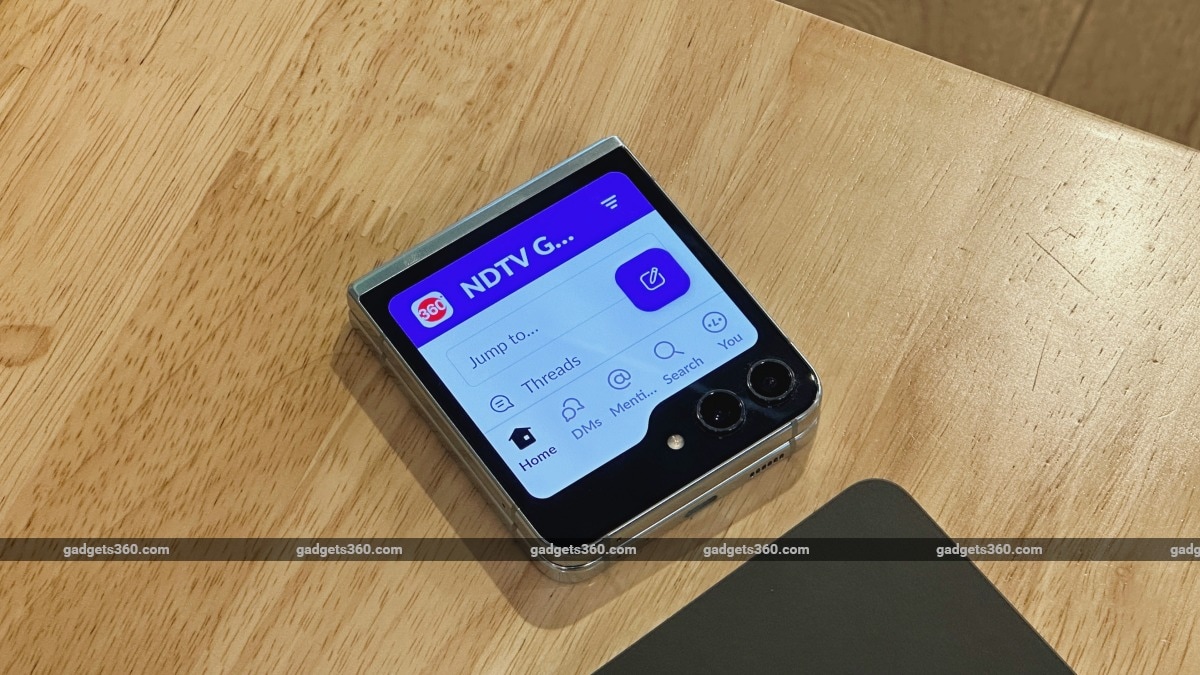
Samsung Galaxy Z Flip 5 front app scaling cover ndtv SamsungGalaxyZFlip5  Samsung

Unsupported apps like Slack do not scale well and need to be restarted from the main display

WhatsApp for example will bypass the standard ‘reply’ and ‘clear’ buttons treatment and directly open the chat window of the related conversation on the cover display itself. While this sounds exciting and fun, it does get quite tiring, because you have to keep jumping in and out of apps from the notifications area when dealing with such notifications.

To a casual user, these three categories of notifications can get extremely irritating because you have to keep in mind which app can reveal usable information (card with a reply button) and which cannot (a simple card). After dealing with this for a few days, I decided to just open up the main display to handle notifications from the drop-down tray like on a regular candybar smartphone.

Currently, the cover display only lets you launch a handful of apps. It isn’t enabled by default and has to be enabled in the Labs section. This includes Google Maps, Messages, Netflix, WhatsApp and YouTube. According to Samsung, these apps have been optimised to run on the outer display, claiming that more apps will be added in the future.

Samsung Galaxy Z Flip 5 cover cutout ndtv SamsungGalaxyZFlip5  Samsung

The cutout to the left of primary camera is solely used by the media player and opens the wrong widget (stock market) when tapped


The implementation works just fine for these supported apps and can help with getting things done without opening the main display. The cover display also supports app transitions from cover display to the main display, letting apps adapt on the fly to the tall aspect ratio of the main display.

However, unlike the Razr, this cannot work the other way around as apps can only transition from the cover display to the main one and not vice versa (or when you fold the phone).

Samsung Galaxy Z Flip 5 performance

While the cover display’s interface is disappointing in its current state, the main display’s software interface of the Samsung Galaxy Z Flip 5 performs quite well. There is no sign of stuttering or lag with One UI running flawlessly despite packing in some bloatware and third-party apps. Thankfully all of these third-party apps can be uninstalled, but it is a bit disappointing that a phone this expensive comes with them out of the box.

As for benchmarks, the Galaxy Z Flip 5 performed as expected. The phone managed a score of 12,87,359 points in AnTuTu and 1,998 and 5,176 points in Geekbench’s single and multi-core tests respectively. These scores are easily the highest figures we have seen coming from a clamshell foldable smartphone till date.

Gaming performance was quite good and better than expected. While I wasn’t satisfied by the Galaxy Z Flip 4’s touch sampling rate when playing games like Call of Duty Mobile, the Galaxy Z Flip 5 does a lot better in this area. Yes, the phone does heat up a bit when running it at ‘Very High’ graphics and ‘Max’ framerate, but performance did not take a hit even after 30 minutes of competitive gaming.

Samsung Galaxy Z Flip 5 cover display time ndtv SamsungGalaxyZFlip5  Samsung

The clock face widgets offer plenty of customisation but aren’t practical


The Samsung Galaxy Z Flip 5’s 3.4-inch outer Super AMOLED display has a standard 60Hz refresh rate but feels smooth in terms of operation. There’s a 6.7-inch full-HD+ AMOLED folding panel inside with a 120Hz refresh rate and its of the LTPO variety, so it can drop its refresh rate down to 1Hz when required to save battery life. Both displays produced saturated colours at default settings, but showed excellent sunlight legibility when viewed outdoors. The main display also supports HDR10+ playback and the dual speakers make for an immersive multimedia experience when watching movies or playing games.

The Galaxy Z Flip 5 lasted a good 16 hours and 45 minutes when put through our video loop battery test, but daily usage figures are a bit concerning. With regular use which involved scrolling through several social media apps, two email accounts on sync, about 30 minutes of camera usage, 30 minutes of gaming and an hour of video streaming and a few calls, the Galaxy Z Flip 5 was down to nine percent at six in the evening after being unplugged from the charger at 7am, which isn’t great even for a foldable.

The main reason could be down to my reduced cover screen usage (mentioned in the software section), which would have been a great way to save on battery life, if done right.

Samsung Galaxy Z Flip 5 main display groove ndtv SamsungGalaxyZFlip5  Samsung

The groove on the main folding display remains the same as on the Samsung Galaxy Z Flip 4


When plugged into a 61W USB PD charger, the phone managed a 26 percent charge in 30 minutes and took a good 2 hours and 14 minutes to complete the charge, which is very slow compared to the competition. Thankfully, the Galaxy Z Flip 5 still retains its wireless charging capability, which is good for trickle charging when the phone is not being used.

Samsung Galaxy Z Flip 5 cameras

With the Galaxy Z Flip 5, Samsung has for the third year in a row, maintained a similar camera system as its predecessor, bringing no new upgrades save for what the latest Qualcomm Snapdragon 8 Gen 2 SoC’s ISP can deliver. The camera hardware remains unchanged over last year’s Galaxy Z Flip 4, which was not too bad to begin with.

There’s a 12-megapixel primary camera with OIS, a 12-megapixel ultra-wide camera, and a 10-megapixel selfie camera which is embedded into the main folding display. The camera interface is similar to what one can find on any Samsung smartphone, save for the fact that the Galaxy Z Flip 5’s primary camera can also be used as a selfie camera. While this is possible on the Galaxy Z Flip 4, the Galaxy Z Flip 5’s larger cover display makes using this mode and framing photos a lot easier. The bigger cover display also makes it possible to snap photos using the rear cameras in tent mode.

Samsung Galaxy Z Flip 5 cover camera ndtv SamsungGalaxyZFlip5  Samsung

The cover display can be used as a viewfinder for framing the perfect shot (using the main cameras) when used as a stand in tent mode


Overall image quality remains very similar when compared to the previous model. The primary camera captures sharp-looking photos in daylight with the typically saturated colours we are used to from Samsung’s smartphones. Details, although sufficient, are still on the lower side and far from the superior imaging capability of the similarly priced Galaxy S23.

Samsung Galaxy Z Flip 5 daylight camera samples from its primary camera


Samsung’s Scene Optimiser is switched on by default and I kept it on for most of this review as the images weren’t drastically enhanced (slightly saturated colours and warmer tones) when compared to the standard photos. Portrait photos captured using the same camera also came out just fine with decent edge detection, but the subjects often came out a bit overexposed and at times with clipped highlights.

The ultra-wide camera captures average photos in daylight but these images are low on resolved detail, especially in the shadows.

Samsung Galaxy Z Flip 5 selfie camera samples


Selfies captured in daylight come out sharp and clear with good edge detection in Portrait mode. However, the primary camera does a far better job at this with much better details and definition, which is why I would strongly recommend using it instead of the selfie camera.

Samsung Galaxy Z Flip 5 low-light camera sample from the primary camera


In low light, the primary camera manages good details when using the auto-night mode (enabled by Scene Optimiser) or the dedicated Night mode. Just like the daylight photos, dynamic range comes up a bit short especially in the shadows. Street-lit scenes have average details and appear a bit oversharpened with crushed blacks in the shadows. The primary camera also has trouble locking focus in dimly-lit scenes, so the resulting photos come out soft, especially when using the Night mode.

Unlike the Motorola Razr 40 Ultra, the Samsung Galaxy Z Flip 5’s camera setup does not include a macro mode. However, the primary camera can focus on objects as close as 10-15cm and the results look just fine.

4K 30fps recorded videos appears average in terms of details, with decent colour saturation but underexposed shadows. Stabilisation is not a problem when shooting at these settings either. 4K 60fps videos showcase a steady framerate but come out shaky. HDR10+ videos recorded at 4K 30fps did not look great even though it managed better detail in the shadows. Low-light video lacked noise, but this led to flattened or blotched textures. 

Verdict

Overall, the Samsung Galaxy Z Flip 5 manages better image and video capability than the Motorola Razr 40 Ultra. But neither should be purchased for this reason alone as both are quite average compared to the competition. If you seek good camera and video quality, the Samsung Galaxy S23 is a much better choice, minus the folding tricks.

Between the Motorola Razr 40 Ultra and the Samsung Galaxy Z Flip 5, I would pick the Razr because of its well-optimised cover display experience, which is currently second to none. Motorola’s MyUX software experience also remains unmatched in terms of minimal bloatware and additional apps, and is also closer to a Google Pixel-like software user experience. Then, there’s the fact that the Razr 40 Ultra also looks so much better with its slick design and that radical-looking cover display.

Where Samsung does stand out is when it comes to overall performance, optimisation and image quality. We’ve compared the Oppo Find N2 Flip with the Galaxy Z Flip 4 previously and Samsung did come out on top back then as well. However, its main standout feature isn’t as useful as I expected it to be. If you own a Galaxy Z Flip 4, I’d recommend sticking with it for now.


Affiliate links may be automatically generated – see our ethics statement for details.

[ad_2]

Source link

Tecno Pova 5 Pro 5G First Impressions: Quirky Design on a Budget

0
Tecno Pova 5 Pro 5G First Impressions: Quirky Design on a Budget

[ad_1]

Tecno has launched its latest smartphones in the Pova series, called the Pova 5 Pro 5G and Pova 5 5G and we got to check out the Pro model. The Pova 5 Pro 5G comes in a glass sandwich design with cyberpunk-style patterns on the back which are visible through the glass. The smartphone comes in two colour options, Dark Illusion, which is what we have, and Silver Fantasy. Prices start at Rs. 14,999 and the phone will go on sale from August 22. 

Tecno POVA 5 Pro back panel Tecno POVA 5 Pro back panel

Tecno Pova 5 Pro 5G in the Dark Illusion colour


The glass back and chrome side rails pick up a lot of fingerprints, which can make the phone look messy really quickly. We have a side-mounted fingerprint sensor in the power key, and the volume buttons are on the right and the SIM slot is on the left. The USB Type-C charging port, microphone, speaker grille and headphone jack are on the bottom. On the top, we have a second speaker grille.

The Tecno Pova 5 Pro 5G sports a 6.78-inch 120Hz full-HD+ LCD display. In my short time with the phone, the display gets bright enough for indoor use but it isn’t easily legible when used outdoors in the day. It does deliver good colours and is quite sharp. The 120Hz refresh rate also aids in a smoother user experience.

Tecno POVA 5 Pro display Tecno POVA 5 Pro display

The Tecno Pova 5 Pro 5G supports up to 2K resolution video playback on YouTube


The phone is powered by a MediaTek Dimensity 6080 5G SoC which handles most tasks with ease and games tend to run just fine at their respective optimal settings. The Pova 5 Pro 5G is available in two configurations, with 128GB or 256GB of storage, both having the same 8GB of RAM.

The smartphone comes equipped with a 50-megapixel main rear camera that seems to snap pretty good images in broad daylight, as well as in not-so-ideal lighting situations. It can record videos up to 2K 30fps and 1080p 60fps, which is not bad for a smartphone in this segment. There’s also a secondary AI camera here, but no ultra-wide.

Tecno POVA 5 Pro camera Tecno POVA 5 Pro camera

The Pova 5 Pro 5G comes equipped with a two rear cameras


The 16-megapixel front camera too captures good images in daylight as well as in indoor lighting situations. The post-processing is also not very aggressive. The colours are good and the images look quite sharp.

The Tecno Pova 5 Pro 5G comes equipped with a 5,000mAh battery which should be enough to get you through one day on a single charge. In my experience, I was easily able to use it for social media browsing, clicking pictures, light gaming and attending calls, and the phone easily lasted one whole day. It does come with a 68W fast charger in the box, which is definitely a plus.

The main highlight of the Pova 5 Pro 5G is what Tecno calls the Arc Interface, which are the glowing LEDs located under the back panel. They light up in different colours when you charge the device, boot it up, receive notifications or even when you listen to music. The LED lights are visible in a well-lit room, but outdoors under bright sunlight, it’s barely visible. You can customise the rate at which the light flashes through the dedicated menu but the options are very limited.

Tecno POVA 5 Pro arc interface Tecno POVA 5 Pro arc interface

The Arc Interface lights up in numerous situations


Last but not least, the smartphone runs HiOS 13.1 which is based on Android 13. Do let us know what you think about the Tecno Pova 5 Pro 5G in the comments.


Affiliate links may be automatically generated – see our ethics statement for details.

[ad_2]

Source link

Oppo A58 4G vs Samsung Galaxy F34 5G: Price in India, Specifications Compared

0
Oppo A58 4G vs Samsung Galaxy F34 5G: Price in India, Specifications Compared

[ad_1]

Oppo A58 4G was launched in India on August 8. The smartphone, priced under Rs. 20,000, is powered by a MediaTek Dimensity 700 SoC paired with Mali-G57 MC2 GPU. It is available in the country in a singular storage configuration. Meanwhile, Samsung Galaxy F34 5G debuted in India a day earlier on August 7. It is equipped by an in-house octa-core Exynos 1280 SoC. The smartphones packs a 6,000mAh battery, while Oppo A58 4G is backed by a 5,000mAh battery. Here is a comparison of both the smartphones, which launched in India this month under Rs. 20,000 segment.

Oppo A58 4G vs Samsung Galaxy F34 5G: Price in India

From the Chinese smartphone company, the Oppo A58 4G is available in a lone 6GB RAM + 128GB storage variant, priced at Rs. 14,999. It is being offered in two colour variants — Black and Green. It can be purchased through Flipkart with additional discounts on bank cards.

On the other hand, Samsung offers the Galaxy F34 5G in two RAM and storage configurations — 6GB RAM + 128GB storage at Rs. 18,999, and an 8GB RAM + 128GB storage option marked at Rs. 20,999. It is available on Flipkart, and can offer discounts on select bank cards. The two colour options for Samsung Galaxy F34 5G include Electric Black and Mystic Green.

Oppo A58 4G vs Samsung Galaxy F34 5G: Specifications, features

Samsung Galaxy F34 5G was launched in India sporting a 6.46-inch full-HD+ sAMOLED display. The smartphone also gets Corning Gorilla Glass 5 protection on the display. Meanwhile, the Oppo A58 4G comes with a 6.72-inch full-HD+ display with a refresh rate of 90Hz. For processor, the smartphone is powered by a MediaTek Helio G85 SoC paired with Mali G52 MC2 GPU, while Galaxy F34 5G gets an in-house octa-core Exynos 1280 SoC.

Both smartphones run on Android 13-based OS. The Oppo A58 4G ships with ColorOS 13.1, whereas the Galaxy F34 5G runs on One UI 5.1.

For optics, the Galaxy F34 5G sports a triple rear camera unit, which includes a 50-megapixel primary sensor, an 8-megapixel sensor with an ultra-wide-angle lens, and a 2-megapixel macro sensor. For selfies, it get a 13-megapixel front camera sensor. The Oppo A58 4G features a dual rear camera setup, with a 50-megapixel primary sensor and a 2-megapixel sensor, alongwith an 8-megapixel front camera sensor.

The 5,000mAh battery on the Oppo A58 4G supports 33W wired SuperVOOC fast charging. The Galaxy F34 packs a large 6,000mAh battery. Both phones feature a side-mounted fingerprint sensor, and gets connectivity support for GPS, NFC, Wi-Fi, Bluetooth v5.3 and USB Type-C.


Samsung launched the Galaxy Z Fold 5 and Galaxy Z Flip 5 alongside the Galaxy Tab S9 series and Galaxy Watch 6 series at its first Galaxy Unpacked event in South Korea. We discuss the company’s new devices and more on the latest episode of Orbital, the Gadgets 360 podcast. Orbital is available on Spotify, Gaana, JioSaavn, Google Podcasts, Apple Podcasts, Amazon Music and wherever you get your podcasts.
Affiliate links may be automatically generated – see our ethics statement for details.

Oppo A58 4G vs Samsung Galaxy F34 5G comparison

 
Oppo A58 4G


Samsung Galaxy F34 5G

Key Specs
Display 6.72-inch 6.46-inch
Processor MediaTek Helio G85 Samsung Exynos 1280
Front Camera 8-megapixel 13-megapixel
Rear Camera 50-megapixel + 2-megapixel 50-megapixel + 8-megapixel + 2-megapixel
RAM 6GB 6GB, 8GB
Storage 128GB 128GB
Battery Capacity 5000mAh 6000mAh
OS Android 13 Android 13
Resolution 2400×1080 pixels 2340×1080 pixels

[ad_2]

Source link

Xiaomi Mix Fold 3 With Overclocked Snapdragon 8 Gen 2 SoC, 16GB RAM Surfaces on Geekbench

0
Xiaomi Mix Fold 3, Slimmer Than Samsung Galaxy Z Fold 5, Launched: Details

[ad_1]

Xiaomi Mix Fold 3 is confirmed to launch in China on August 14 and the brand is actively teasing the design and specifications of the handset via Weibo. Just days ahead of its formal debut, a Xiaomi smartphone, believed to be Xiaomi Mix Fold 3, has appeared on the Geekbench benchmarking site with an overclocked version of the Snapdragon 8 Gen 2 SoC. It is shown with Android 13 OS. The foldable smartphone is confirmed to come with an 8.02-inch foldable AMOLED display and Leica-branded quad rear cameras.

A Xiaomi smartphone has been spotted on the Geekbench website with model number 2308CPXD0C. The listing, which is thought to be of Xiaomi Mix Fold 3, shows 2,071 points in single-core testing and 5,419 points in multi-core testing. As per the listing, the handset could get 14.84GB of RAM, this could translate to 16GB on paper. The listing is dated Friday, August 11.

Further, the listing suggests that an octa-core chipset will power the Xiaomi Mix Fold 3. It shows a prime CPU core with a maximum clock speed of 3.36GHz, four cores with a clock speed of 2.80GHz and three cores capped at 2.02GHz. These CPU speeds suggest an overclocked version of the Snapdragon 8 Gen 2 SoC. The original version of the Snapdragon 8 Gen 2 SoC has a prime CPU core with a maximum clock speed of 3.2GHz.

The Geekbench listing was initially spotted by Nashville Chatter, however, Gadgets 360 was able to independently verify it.

Xiaomi already announced that the launch of Mix Fold 3 will take place at 7:00pm local time (4:30pm IST) on August 14 in China. The event will also see the debut of the Xiaomi Band 8 Pro and Xiaomi Pad 6 Max.

The Mix Fold 3 is teased to feature an 8.02-inch foldable AMOLED display on the inside with 120Hz refresh rate and a peak brightness of 2,600 nits. The handset is claimed to survive 5,00,000 folds. It has a Leica-branded quad rear camera unit and is confirmed to include Corning Gorilla Victus 2 protection. Xiaomi says that the handset can deliver up to 1.34 days of battery life.


Xiaomi launched its camera focussed flagship Xiaomi 13 Ultra smartphone, while Apple opened it’s first stores in India this week. We discuss these developments, as well as other reports on smartphone-related rumours and more on Orbital, the Gadgets 360 podcast. Orbital is available on Spotify, Gaana, JioSaavn, Google Podcasts, Apple Podcasts, Amazon Music and wherever you get your podcasts.
Affiliate links may be automatically generated – see our ethics statement for details.

[ad_2]

Source link

Samsung Galaxy Z Flip 5: Is This the Best Foldable Phone You Can Buy in India Right Now?

0
Samsung Galaxy Z Flip 5: Is This the Best Foldable Phone You Can Buy in India Right Now?

[ad_1]

Samsung Galaxy Z Flip 5 was launched by the company last month, and the foldable handset will go on sale in the country alongside the Galaxy Z Fold 5 on August 18, the company confirmed on Friday. The latest foldable phones from the South Korean tech conglomerate were unveiled at its first Galaxy Unpacked event in Seoul, South Korea. This year, Samsung brought a few notable hardware upgrades to the Galaxy Z Flip 5 including the processor, hinge, and the outer screen.

Senior Reviewer Sheldon Pinto, who attended the recent Galaxy Unpacked event talks to guest host and Reviews Editor, Roydon Cerejo about the Samsung Galaxy Z Flip 5 on this week’s episode of Orbital, the Gadgets 360 podcast. The two discuss the pros and cons of the phone, which we’ve covered in detail in our review of the smartphone which will be published on Gadgets 360 in the coming days.

Even if you want to buy the Samsung Galaxy Z Flip 5 in India, you’ll have to wait until next week — Samsung said on Friday that it has started to ship the new foldables to customers who pre-ordered them after they were launched in July. This year, customers who purchase the Galaxy Z Flip 5 will have access to a larger cover display which — unlike its closest competitor, the Motorola Razr 40 Ultra — uses a widget-based design for external apps.

Under the hood is Qualcomm’s custom Snapdragon 8 Gen 2 Mobile Platform for Galaxy. This chipset was first introduced on the Samsung Galaxy S23 series of smartphones, and is a slightly overclocked version of the chipmaker’s top-of-the-line offering that is found on other flagship phones launched this year.

Camera hardware on the Galaxy Z Flip 5 remains largely unchanged compared to the one its predecessor, and it appears that the majority of photo quality improvements will come from the improved chipset on the foldable phone. The Flex Mode will let you take higher quality selfies using the outer display that also doubles as a viewfinder. 

While the Galaxy Z Flip 5 has the same battery as its predecessor, the battery performance might not be as reliable as last year’s model. You can read our detailed review of the phone to find out more about the handset. This year, Samsung has retained the same IPX8 rating for water resistance, which means that exposure to dust and dirt could cause issues for the handset in the long run.

If you’re new to the Gadgets 360 website, you can easily find the Gadgets 360 podcast Orbital on your favourite platform — be it Amazon MusicApple PodcastsGoogle PodcastsGaanaJioSaavnSpotify, or wherever you listen to your podcasts.

Don’t forget to follow the Gadgets 360 podcast wherever you’re listening. Please also rate us and leave a review.


[ad_2]

Source link

Poco Pods True Wireless Earphones Review: Inexpensive and Easy Going

0
Poco Pods True Wireless Earphones Review: Inexpensive and Easy Going

[ad_1]

Smartphone brands entering the accessories space is not a new thing, and many such as Xiaomi, Oppo, OnePlus, Samsung, and Apple have established product ranges in the true wireless audio segment. The latest to give it a shot is Poco, which operates in India as a sub-brand of Xiaomi, and has been a noteworthy player in the mid-range smartphone segment. The company’s first audio product is firmly an entry-level offering.

Priced at Rs. 1,199 in India, the Poco Pods true wireless earphones isn’t too complex or feature-rich, but they don’t cost a lot either. This headset is as basic as it gets, but perhaps that’s exactly what some might need. Find out if the Poco Pods is indeed worth the price, and if it’s the best affordable true wireless headset you can buy right now.

poco pods review open Poco

The Poco Pods have a proper in-canal fit with good noise isolation, and a decently-sized charging case


Poco Pods design, features, and specifications

The Poco Pods headset has what I consider a very generic look and feel (it looks a lot like the Redmi Buds 4 Active), but this isn’t a bad thing. The earpieces are light and fairly durable, with a proper in-canal fit and stem design. The headset is available in a single black-and-yellow colour option — Poco’s signature colour scheme. If that wasn’t enough, the large Poco logo on the front of the all-black charging case sufficiently makes the point.

The earpieces have touch-sensitive areas for controls, but the lack of app support on the Poco Pods means that the controls are fixed and non-customisable. A double-tap gesture will let you answer calls or play and pause music, while a triple tap on either side cancel the call or skip to the next track. You can’t skip to the previous track from the earphones; you’ll need the paired smartphone to do that.

A long press on both earpieces simultaneously will activate or disable the low-latency mode. There are a couple of other gestures meant to put the headset into forced pairing mode or factory reset the Poco Pods, but you can simply put the earphones into pairing mode by disconnecting all other connected and paired devices. On the whole, the system functions are fairly easy and uncomplicated, as you’d expect from a true wireless headset which doesn’t have app support.

The charging case has a small indicator light at the bottom, alongside the USB Type-C charging port. The fit on the earpieces is decent, and the Poco Pods come with environmental noise cancellation, which promises better performance on calls. The sales package includes a total of three pairs of silicone ear tips of different sizes, but no charging cable is included in the box.

As mentioned earlier, there is no app support on the Poco Pods, but I wouldn’t go as far as to call this a drawback on a headset in this price range. Fortunately, you do get the basics such as USB Type-C charging, as well as the benefits of features such as environmental noise cancellation and 60ms low-latency for use when gaming.

poco pods review case Poco

The Poco Pods is available in just a single colour for now; black and yellow


The Poco Pods headset has 12mm dynamic drivers, and uses Bluetooth 5.3 for connectivity, with support for only the SBC Bluetooth codec — a disappointing spec even at this price. Usefully, either earpiece can be used individually if you like, with the other securely stored in the charging case and not affecting stable connectivity for the earpiece in operation.

Poco Pods performance and battery life

I tend to keep my expectations tempered when it comes to affordable true wireless earphones; you’re paying almost entirely for the form factor here, and saving on paying premiums for the ‘fluff’, so to speak. The Poco Pods largely deliver that straightforward true wireless experience, but the sound quality is perhaps not as good as it could have been, even considering the affordable pricing.

Detailed tuning might be too much to expect here, but the crux of the Poco Pods’ shortcomings can be pinned on its codec limitations. The SBC codec doesn’t quite allow enough bandwidth for the earphones to work with, and this can be heard in the sound quality. It sounds unrefined at times, although it doesn’t reach a point of being unpleasant even at high volumes. It’s listenable considering the price, and useful if you just need earphones to help you tune out your surroundings.

poco pods review earpieces Poco Pods

The earpieces of the Poco Pods are light and comfortable, with non-customisable touch controls


Starting with David Guetta’s Stay (Don’t Go Away), the sound initially sounded alright when the track itself wasn’t pushing too hard, but as the attack picked up, the Poco Pods started to sound a bit muffled. I wouldn’t go as far as to call it muddy or too harsh, and the sound might even appeal to those who enjoy hearing a bit more from the bass frequencies.

Certain genres and types of tracks are admittedly better suited to this kind of tuning and sound, with many of Croatia Squad’s distinctly beat-driven tracks sounding rather enjoyable on the Poco Pods. The progressive and rather straightforward attack of Make Your Move by Croatia Squad was perhaps the best example of how a niche (or genre, in this case) can be found to bring the best out of even affordable wireless earphones. The lack of detail in the track was evident, but matters less with certain tracks and genres such as this.

Call quality is acceptable and workable enough for both indoor and outdoor use; microphone performance is decent in quiet rooms, but suffered a bit outdoors despite the presence of ENC. Low-latency mode didn’t seem to make much of a difference in audio latency on basic mobile games.

Battery life is decent on the Poco Pods, with the earphones running for around five hours on a single charge of the earpieces, and the charging case offering over three full additional charges, for a total run time of around 22-23 hours per charge cycle, which is a bit lower than the claimed time of 30 hours. This is somewhat expected given the lack of features and codec support, but users will obviously find this good enough for practical all-day listening.

Verdict

The Poco Pods true wireless headset delivers largely what you expect from a headset in this price range — nothing more, and nothing less. The earphones are basic, but reasonably well set up for the kind of music that most budget buyers might want to listen to. Don’t expect too much detail, and use these for casual listening, particularly when out and about thanks to the decent passive noise isolation. Battery life is decent as well.

There is plenty of competition in this price segment, but Poco’s first effort in the true wireless audio space is a commendable effort. Perhaps the only real drawback is the lack of support for the AAC Bluetooth codec, but all things considered this is a worthwhile pair of earphones if you have a very tight budget.


Affiliate links may be automatically generated – see our ethics statement for details.

[ad_2]

Source link